
Demand Planners Are Not Data Scientists — And That's Okay
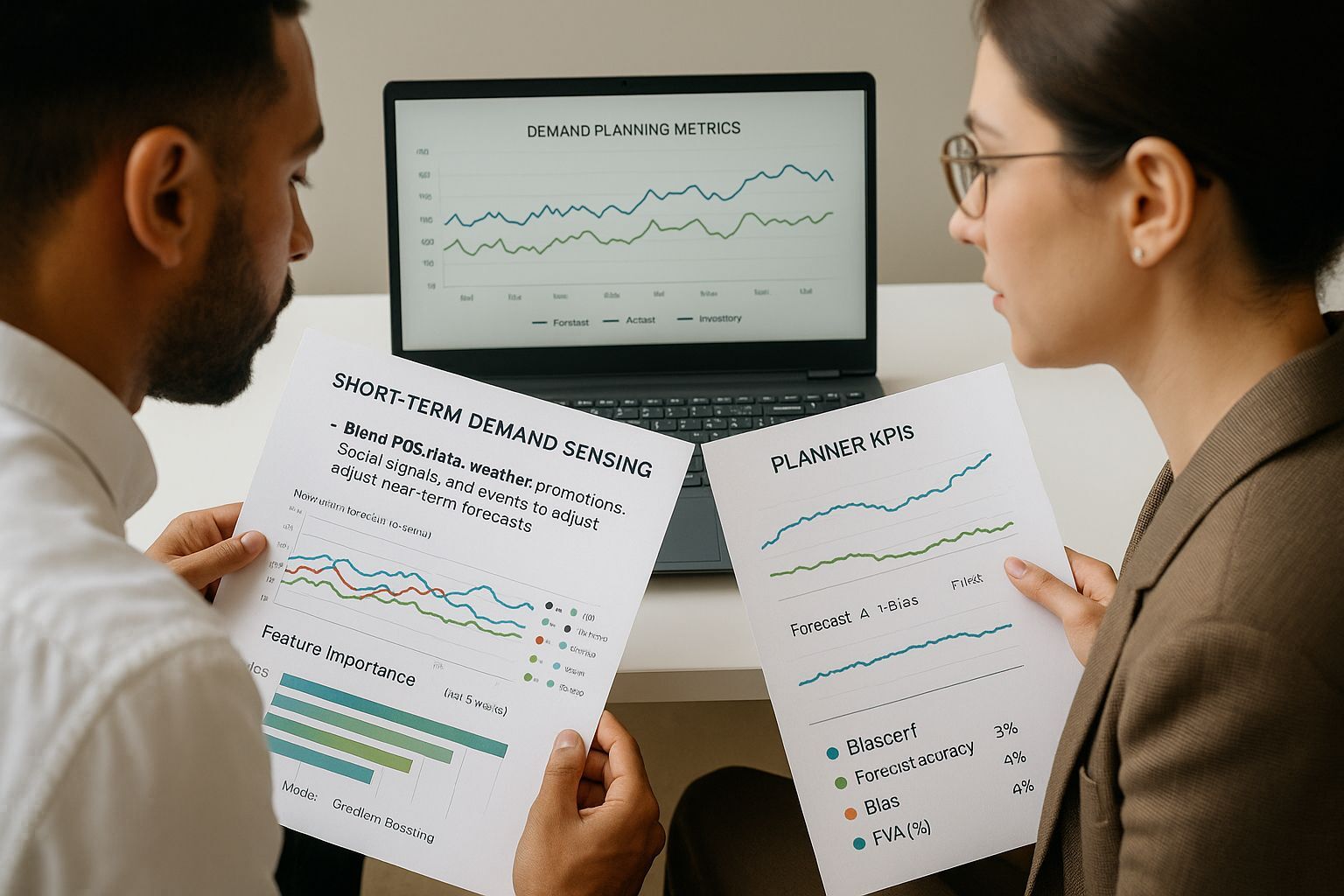
The sustainable model is a partnership between two distinct but complementary skill sets.
There's a growing chorus suggesting that demand planners should evolve into data scientists. It's a seductive idea: planners armed with algorithms, seamlessly blending business sense with statistical modeling. But the reality inside most organizations looks very different.
The Demand Planner's Role
Demand planners are business people at heart. Their work is central to S&OP:
- Building forecasts for finished products
- Adjusting those forecasts based on promotions, launches, or competitive moves
- Aligning numbers with sales, marketing, and finance
- Explaining changes and mediating between ambition and operational feasibility
Planners rarely have deep mathematical training. Their strength lies in contextualizing data and securing alignment, not coding algorithms.
The Data Scientist's Role
Data scientists bring another, equally vital skill set:
- Structuring and cleaning large volumes of data
- Building and validating statistical or machine learning models
- Working with probabilistic forecasts rather than point numbers
- Coding in Python or R, and scaling models across thousands of SKUs
Their world is technical and math-heavy. It complements, but doesn't replace, the planner's business-facing work.
Why Merging the Roles Doesn't Work
Some argue these roles should be merged into one. But in most companies, that's unrealistic:
- Few planners have the training to become statisticians overnight
- Few data scientists want to spend their time in weekly forecast alignment meetings
The danger is creating a role definition that fits no one — leaving forecasting caught between black-box models and gut-feel adjustments.
A Better Approach: Division of Labor
The sustainable model is a partnership:
- Data scientists design and maintain the forecasting engines, ensuring robust and probabilistic predictions
- Demand planners interpret these outputs, enrich them with business knowledge, and secure alignment across the organization
This division respects both disciplines and ensures the process is both mathematically sound and organizationally credible.
What the Right Tool Should Do
To make this partnership work, the supporting system must:
- Allow data scientists to embed advanced models and pipelines without constraining them to rigid templates
- Provide planners with a clear, user-friendly interface to review forecasts, apply business insights, and collaborate with stakeholders
- Keep the math in the background, while surfacing only what planners need to act confidently
- Support probabilistic forecasting but translate it into formats that business users can readily consume
Final Thought
The future of demand planning doesn't lie in turning planners into statisticians, nor in leaving scientists to decide numbers in isolation. It lies in partnership, supported by tools that recognize the distinct strengths of each role. That way, organizations get the best of both worlds: mathematically robust forecasts and business-aligned decisions.