
EOQ Is Not a Planning Tool — It's a Dangerous Academic Relic
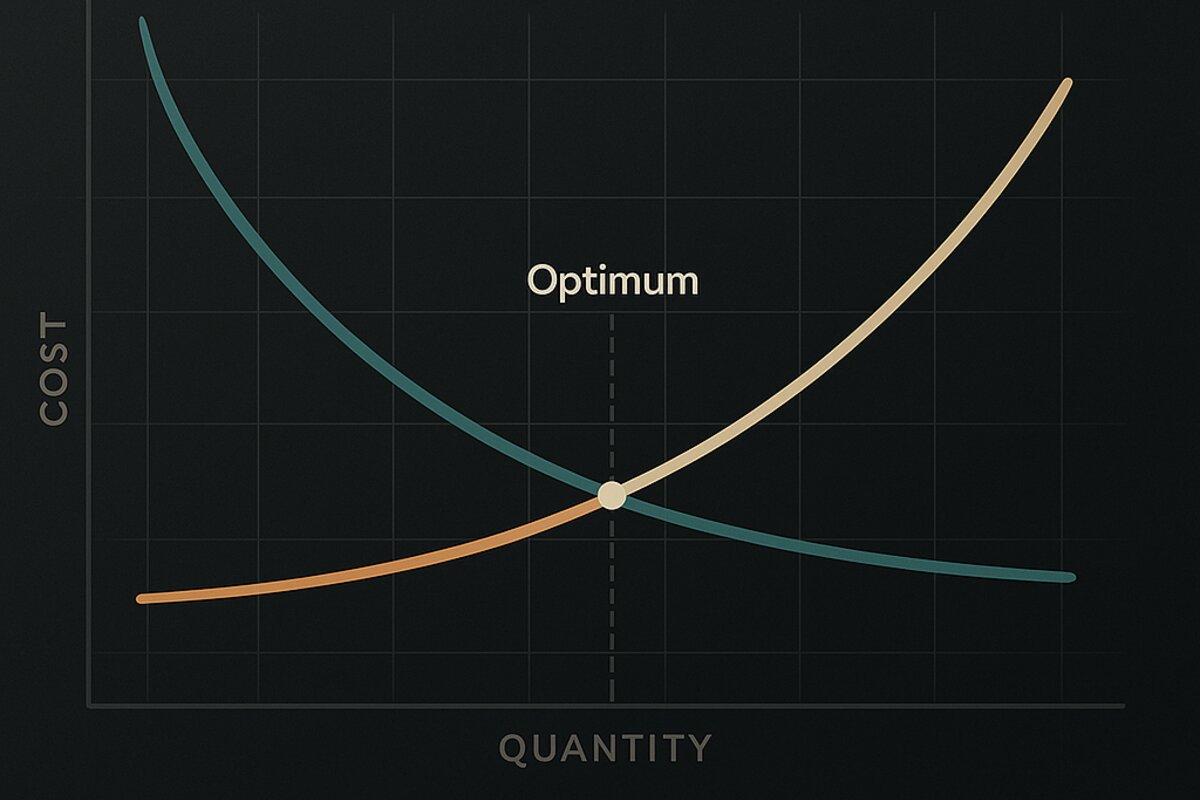
Let's say it clearly: EOQ should never be used in real-world supply chains.
It was never designed for it. It is not fit for it. And yet it still lingers in planning processes, software systems, and consulting slide decks.
As a mathematician, former production plant director, and supply chain architect, I've spent nearly 20 years in operations. I have never seen a case where EOQ logic produced valid or resilient results. Not one.
EOQ Was Built to Illustrate a Concept — Not to Run a Business
The Economic Order Quantity (EOQ) formula:
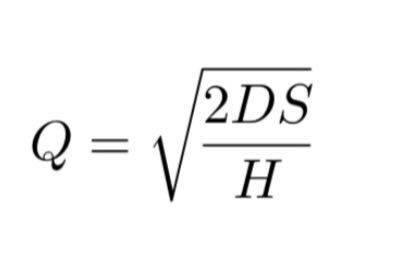
Where:
Q = Economic Order Quantity
D = Annual demand
S = Ordering cost per order
H = Holding cost per unit per year
This formula was introduced by Ford W. Harris in 1913 to illustrate the cost tradeoff between ordering frequently (which increases transaction costs) and ordering in large batches (which increases holding cost).
It was never meant to model:
- Volatile or intermittent demand
- MOQ, lead time constraints, or storage limits
- Promotions, perishability, or capacity constraints
- Any real-world business process
It's a teaching tool — not a supply chain model.
Sensitivity Alone Makes EOQ Inapplicable
Even if its assumptions were remotely realistic — which they aren't — the formula is so sensitive to cost inputs that it's mathematically reckless to apply in real planning systems.
Here's the math:

% change in Q = 1⁄2 × % change in input
If your estimate for S (ordering cost) or H (holding cost) is off by 20% — which is common — your EOQ will be off by approximately 10%.
But that's in theory. In practice, errors compound through lead times, buffers, and inventory mismatches.
In short: EOQ is structurally fragile. It gives planners a false sense of precision while silently eroding performance.
Peer-Reviewed Evidence: EOQ = Higher Cost
A 2024 study published in Operations Research Letters titled Dynamic Replenishment Strategies under Uncertainty: Revisiting the EOQ Paradigm by Wang et al. (Vol. 52, Issue 1) benchmarked EOQ against stochastic and simulation-based policies.
Key finding: "EOQ-based heuristics generated 15–25% higher total cost across all tested environments when compared to even basic demand-responsive policies."
This isn't a marginal penalty. It's a strategic liability.
Why Are We Still Using It?
- It's easy to teach.
- It's embedded in ERP systems.
- It sounds scientific.
That's why consultants still include it — not because it's effective, but because it's palatable and billable.
But if your software or strategy still uses EOQ in 2025, you're planning with a century-old tool that assumes away uncertainty.
That's not planning. That's negligence.
What Actually Works
The modern world demands logic that reflects its complexity. You need lot-sizing logic that:
- Understands real constraints
- Adapts to volatility
- Performs under uncertainty
What works:
- Simulation-based planning (e.g., discrete-event, Monte Carlo)
- Machine learning reorder logic (trained on actual behavior)
- Dynamic heuristics (rolling horizon, order-up-to policies)
These models do not need perfect cost values. They need data, rules, and calibration — all achievable with modern systems.
Stop Using EOQ — Today
You wouldn't use Newtonian mechanics to simulate a satellite launch. You wouldn't use a sundial for time-on-target delivery.
So why use EOQ for critical replenishment decisions?
At Binomium, we're replacing brittle algebra with resilient simulation. We model constraints, risks, and costs as they really behave — not as textbooks once hoped they might.
Let's Talk
EOQ is over.
Audit your systems. Challenge your vendors. Upgrade your logic.
If you're ready to operate in the real world, let's talk.